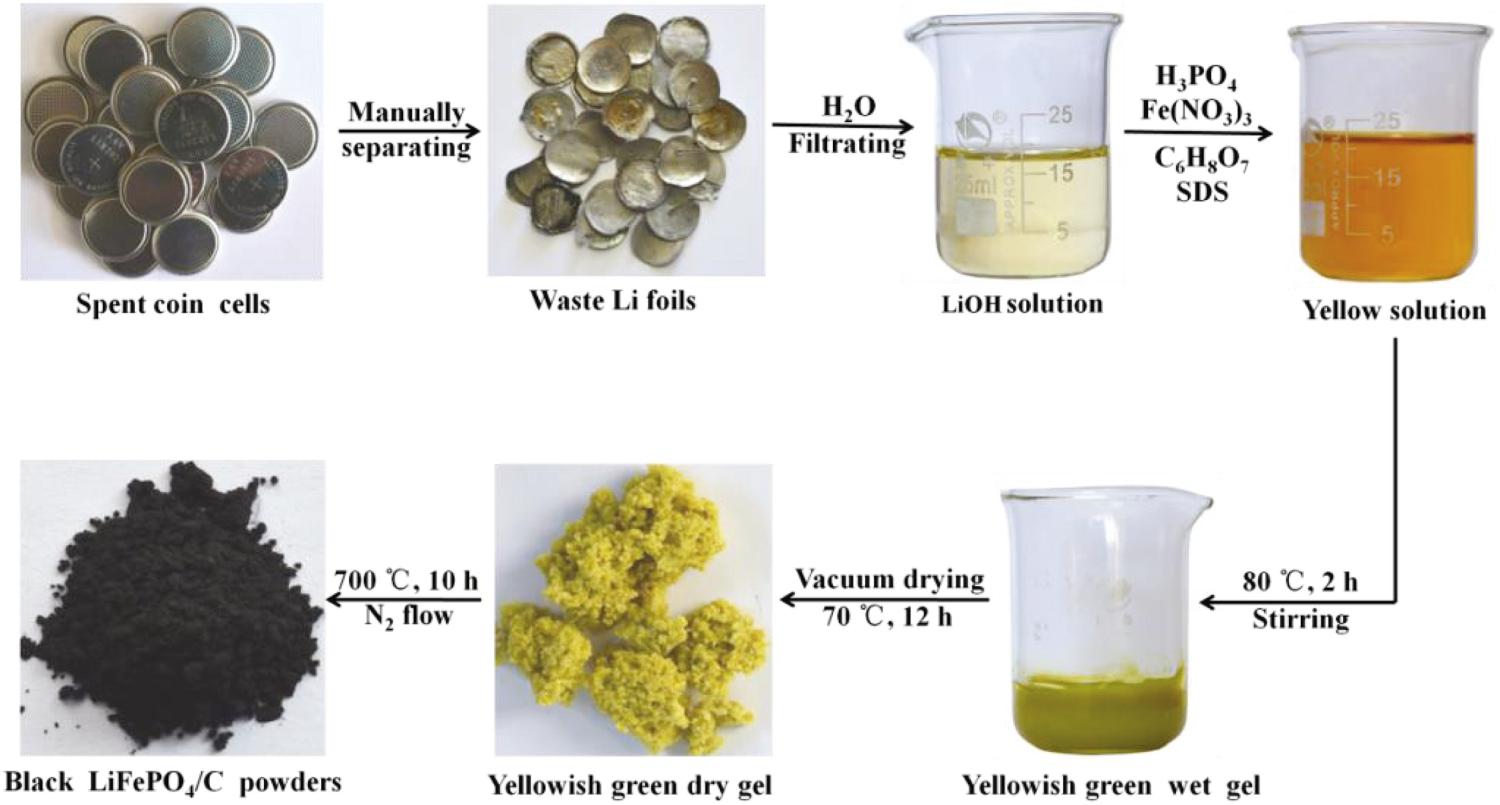
Waste Li foils in the spent experimental Li-coin-cells may bring the potential risk and the waste of Li-resource if they aren't reasonably treated in time. For this purpose, waste Li foils were recycled in the form of black LiFePO4/C powders with the recovery of about 80% in this work. The obtained LiFePO4/C powders were investigated in term of X-ray diffraction (XRD), scanning electron microscope (SEM), energy dispersive X-ray spectrum (EDX), inductively coupled plasma optical emission spectrometer (ICP-OES), transmission electron microscopy (TEM), nitrogen adsorption/desorption, galvanostatic charge/discharge, cyclic voltammetry (CV) and AC impedance spectroscopy. The results showed that black LiFePO4/C powders consisted of many nano/micro particles with the specific surface area of 89.0 m2/g; furthermore, LiFePO4/C cathode also delivered the satisfactory electrochemical performances. For example, the initial discharge capacity was 127.5 mAh/g and the reversible discharge capacity after 110 cycles was about 114.5 mAh/g at 0.1C. Seemingly, the satisfactory results may open a new avenue to develop the circular economy and the sustainable energy.