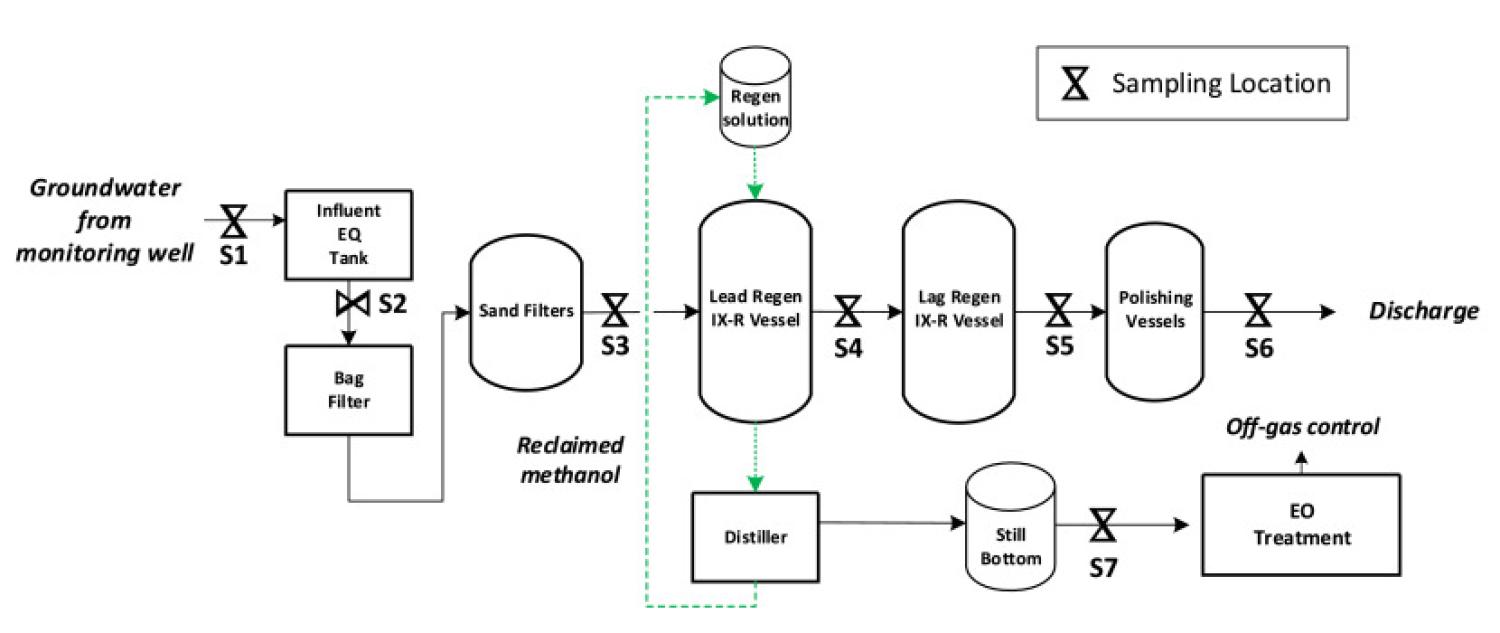
This pilot-scale field demonstration evaluated the remediation of poly- and perfluoroalkyl substances (PFAS) from groundwater contaminated with aqueous film-forming foam (AFFF) from a coupled regenerable ion exchange resin (IXR) and electrochemical oxidation (EO) treatment train. A pilot-scale IXR system was used that incorporates a novel resin regeneration process, and recovers and reuses the majority of the regenerant solution using distillation. The pilot system removed PFAS from ∼1,000,000 L (approximately 260,000 gallons) of contaminated groundwater from a fire training area, and treated effluent from the IXR system was non-detect for PFOA and PFOS. The concentrated waste stream (i.e., still bottom) from IXR was treated on-site by an EO system with Ti4O7 electrodes, achieving 80–98% destruction of PFOA and PFOS. The surface area normalized first-order rate constants (kSA) were 3.96 × 10⁻⁷ m s−1 and 7.92 × 10⁻⁷ m s−1 for PFOA and PFOS, respectively, with short-chain perfluoroalkyl acids (PFAAs) identified as intermediate degradation products. Based on the fluoride recovered and PFAS mass loss measured at the end of EO treatment, fluoride release ratios were 130% for still bottom sample 1 (SB1) and 215% for still bottom sample 2 (SB2), indicating mineralization of unquantified fluorinated compounds in the waste stream. Overall, the electric energy consumed per order of magnitude reduction in concentration (EE/O) for treating PFOA and PFOS in groundwater by the IXR-EO treatment train was 0.131–0.161 kWh/m3 for PFOA and 0.071–0.094 kWh/m3 for PFOS, which was orders of magnitude lower than the reported EE/O values for stand-alone electrochemical treatment. The results of this field demonstration show the promise of coupling regenerable IXR with EO for cost-effective removal, concentrating, and destroying PFAS from groundwater.