Protect, restore and promote sustainable use of terrestrial ecosystems, sustainably manage forests, combat desertification, and halt and reverse land degradation and halt biodiversity loss
Elsevier, World Development, Volume 126, February 2020
With the increasing importance of ‘emerging powers’ in the global economy, questions are raised about the role of developing countries in shaping global norms.
Elsevier, Remote Sensing of Environment, Volume 237, February 2020
Sustainable Development Goal (SDG) indicator 15.1.1 proposes to quantify “Forest area as a proportion of total land area” in order to achieve SDG target 15.1.
Elsevier, One Earth, Volume 2, Issue 1, 2020, Pages 98-108
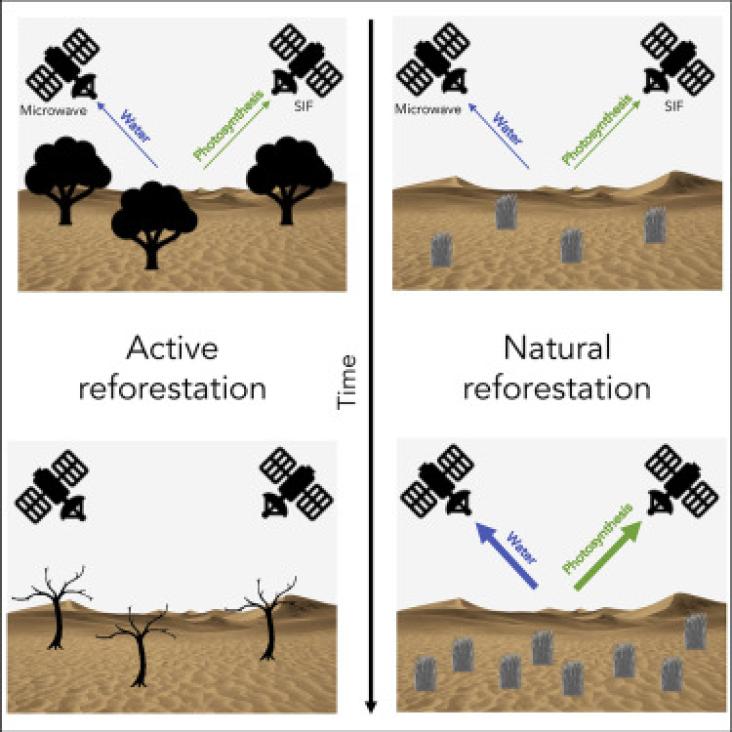
We assess the success of natural reforestation in China's TNSP using satellite data. We use microwaves and SIF to measure water and photosynthesis in dryland vegetation. A strong correlation is found between reforestation and remote sensing data. Natural reforestation is successful at increasing vegetation activity in arid areas
Elsevier, One Earth, Volume 2, Issue 1, 2020, Pages 98-108
In this study, we use a new type of satellite data looking at vegetation water and photosynthesis to compare the success of different reforestation methods, using China's Three-North Shelterbelt Program as a case study.
Biodiversity is in rapid decline, largely driven by habitat loss and degradation. Protected area establishment and management are widely used to maintain habitats and species in perpetuity.
Elsevier, European Journal of Soil Biology, Volume 96, January - February 2020
Recent perspective has highlighted the microbial importance of interplay between catabolic breakdown and anabolic synthesis in influencing soil organic carbon (SOC) dynamics and persistence.
Elsevier, Agricultural Systems, Volume 177, January 2020
Elucidating relationships between the soil food web, soil processes, and agroecosystem function is a critical step toward a more sustainable agriculture.