This special issue explores the influence that insects and other invertebrates have on ecosystem services and the Sustainable Development Goals (SDGs), and makes a case for insect science to promote a sustainability science approach.
Elsevier, Journal of Transport and Health, Volume 18, September 2020
Introduction: Transport, a well-recognised determinant of health, is particularly salient to well-being and equitable health outcomes amongst older people and people living with disabilities living
Elsevier, Current Opinion in Insect Science, Volume 40, August 2020
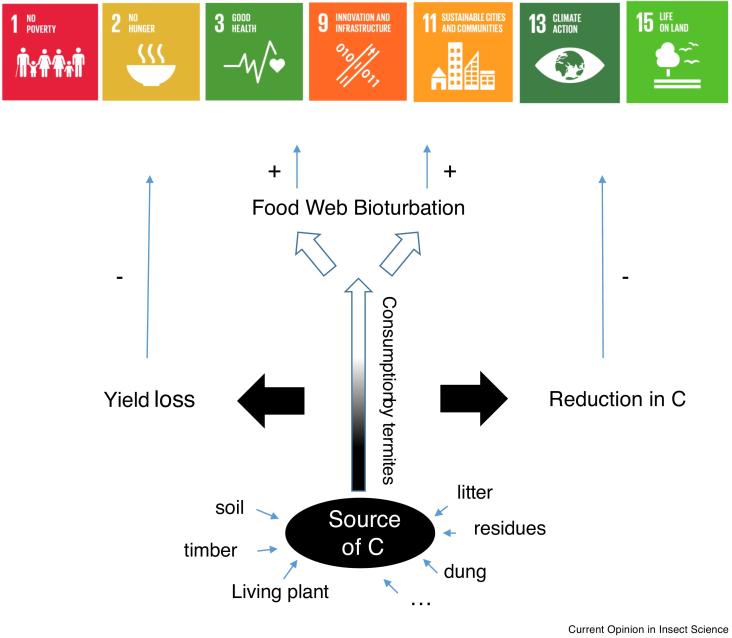
Termites are amongst the main macroinvertebrate decomposers in tropical ecosystems and they exert additional impacts through the creation of biostructures (mounds, galleries, sheetings, etc.) with
Elsevier, Current Opinion in Insect Science, Volume 40, August 2020
Materials, structures, surfaces and buildings of insects are of a great scientific interest, but such basic knowledge about the functional principles of these structures is also highly relevant for
Elsevier, Sustainable Development Strategies, Engineering, Culture and Economics, 2021, Pages 1-25
This book chapter advances SDG 11 and 13 by introducing the concepts of sustainable development. The definitions as evolved over time have been briefly discussed. The evolution of the sustainable development concepts coupled with the underling theorems, philosophy, ethics, and social responsibility has also been described. The dimensions of sustainable development along with the recent trends have also been discussed.
Elsevier, William H. Schlesinger, Emily S. Bernhardt, Chapter 11 - The Global Carbon and Oxygen Cycles, Editor(s): William H. Schlesinger, Emily S. Bernhardt,
Life is composed primarily of carbon, so estimates of the global production and destruction of organic carbon give us an overall index of the health of the biosphere. This book chapter advances SDGs 11 and 13.
Elsevier, Reaching Net Zero, What It Takes to Solve the Global Climate Crisis, 2020, Pages 107-122
This book chapter advances SDG 11, 13, 17 by describing the Intergovernmental Panel on Climate Change and other reports on the need to limit global temperature increase to 2.0°C and preferably 1.5°C. The chapter outlines possible scenarios and introduces the concept of “net zero” by 2050, the essential elimination of greenhouse gas emissions. The chapter also discusses why this deadline is not achievable and presents a more likely scenario.
The new 2030 sustainable development agenda is likely to dominate policy and academic debates at both national and international levels over next 15 years and beyond.