In this episode of the "World We Want" podcast, Márcia Balisciano interviews Klaus Brun, Vice President of Products and Technology, Ebara-Elliott Energy. They discuss why clean, reliable energy is essential for global sustainability and what technologies like turbines and hydrogen/CO₂ transport are needed for the transition. They also note how AI both raises energy demand and helps improve system efficiency.
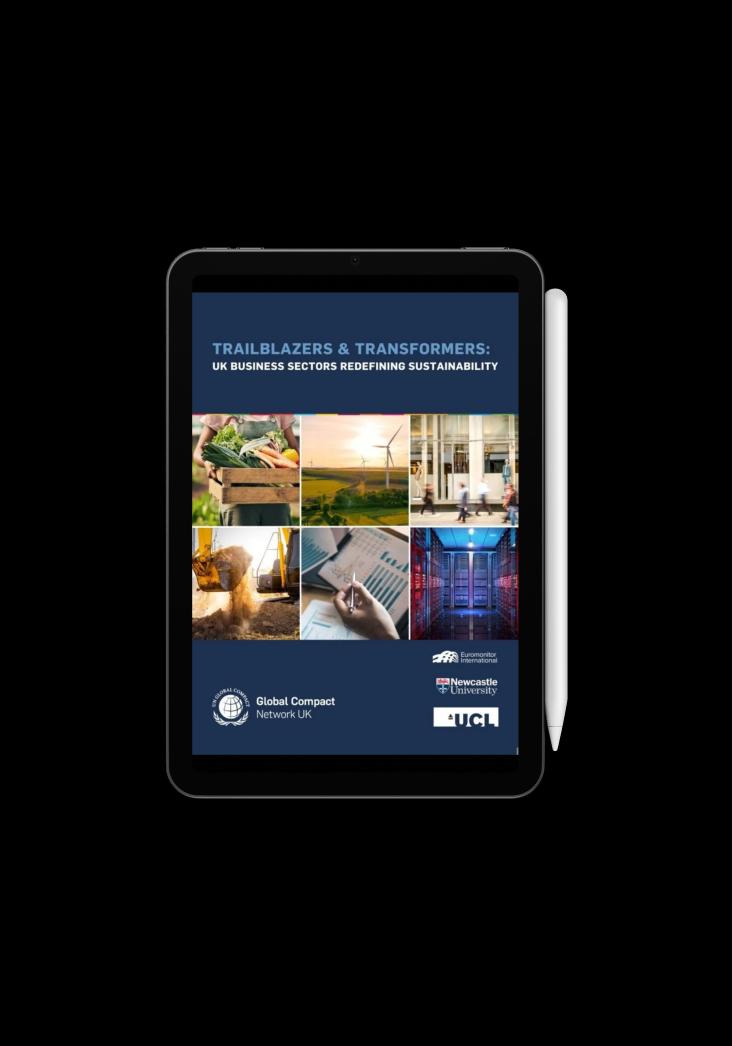
Front cover of the Trailblazers & Transformers report featuring images including a wind turbine and a crate of vegetables

To help companies strengthen competitiveness and resilience, the UN Global Compact Network UK, in collaboration with University College London, Newcastle University, and Euromonitor International,

In this episode of the “World We Want” podcast, Márcia Balisciano interviews Professor Jurgita Malinauskaite, Professor of law and Head of Brunel Law School at Brunel University of London. They discuss the role of law, research, and collaboration in driving sustainability, from fair competition and energy transitions to circular economy solutions, all in alignment with the UN Sustainable Development Goals.

Observed on Monday, October 6, 2026, World Habitat Day focuses global attention on the state of towns and cities and

In this episode of the "World We Want" podcast, Márcia Balisciano interviews Mandi McReynolds, Chief Sustainability Officer and Vice President of External Affairs and Customer Advocacy at Workiva. They discuss corporate responsibility, environmental, social, and governance (ESG) initiatives, and the alignment of these strategies with the UN Sustainable Development Goals (SDGs).
In this episode of the "World We Want" podcast, Márcia Balisciano interviews Simona Bianchi, Assistant Professor at the ReStruct Group in the Faculty of Architecture at TU Delft. They talk about advancing climate-resilient building technologies, sustainable urban development, and the critical role of interdisciplinary collaboration in aligning research with the UN Sustainable Development Goals.

This study develops a capacity expansion model with grid operational detail and high spatial resolution to examine decadal pathways to carbon neutrality by 2060 considering localized and temporal impacts.

Elsevier,

Meeting SDGs in Smart City Infrastructures, Federation, Interoperability, and Discoverability, Smart Cities, 2026, Pages 151-189

This chapter supports UN SDGs 11, 7, and 3 by discussing how AI can improve various aspects of urban planning, transportation, public safety, and environmental management to create more livable and sustainable cities; highlighting AI as a key enabler for optimizing energy distribution, identifying areas for conservation, and integrating renewable energy sources to help cities achieve climate-neutrality goals; and explaining how AI can enhance healthcare services through personalized monitoring, diagnosis, and treatment, as well as improve access to basic healthcare for citizens.

Pages