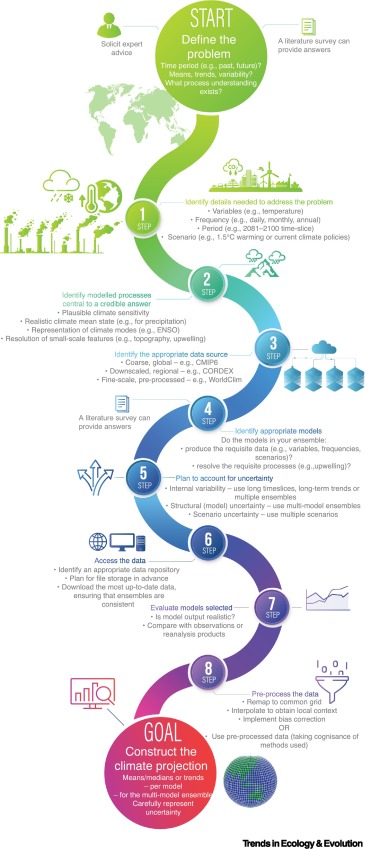
To plan for an uncertain future, life scientists are often required to use the output from climate models to develop recommendations for policy. The authors explain best practice for use of these models, this research supports SDG 2, 13, 14 and 15.
PLMP leverages the interdependencies in the semantic network to project markers from the social discourse level (tweets) to the word level, allowing for a richer interpretation of the online sentiment. The authors apply PLMP to analyze online discourse around three major events: #MeToo, #FridaysForFuture, and #Covid19
This article advances SDG # 3, 4, 8, 10 and 13 by compiling evidence showing that climate change and its various consequences can adversely affect brain development in the fetal through the early childhood stages. Long-term consequences on health, education and economies are significant. T
This article advances SDG # 13 through its Visual Earth (art feature) depicting the need to act now on Climate Change.
This article advances SDG # 13 by arguing that flaws with carbon offsets, such as exaggerated climate benefits, emission avoidance rather than carbon removal, non-durable carbon storage, greenwashing, and double-counting, ultimately make the current system incompatible with the Paris Agreement.
The data in this study highlights how important it is for future mental health policy and practice to incorporate support for those experiencing climate-related emotional distress and its mental health impacts.
Nightmares are a re-experiencing symptom of Post-Traumatic Stress Disorder (PTSD) and Complex PTSD (CPTSD). Nightmare features are associated with PTSD and CPTSD symptom-severity. Other variables may better predict CPTSD.
In this study, the relationship between levels of dissociation, several pre-placement factors and other background variables was explored to facilitate understanding of the high prevalence of dissociation in adolescents living in care.
How people commute to work can have a significant effect on their mental health. This article shows that private car is worse than public or active transport in this respect. Policy measures can encourage people to use modes of transport that promote better mental health.
This editorial highlights the urgent unmet need to develop and test more treatment options for mental disorders.