Gender equality and women's empowerment play a vital role in achieving the Sustainable Development Goals (SDGs) outlined by the United Nations. Acknowledging the significance of SDG 5, which explicitly targets gender equality and the empowerment of all women and girls, it's worth noting that these elements are fundamentally tied to all 17 goals. Each goal, whether it pertains to poverty eradication, quality education, or climate action, is directly or indirectly affected by gender dynamics. Gender inequality inhibits economic growth (SDG 8) by depriving economies of the full potential of half its population, thereby exacerbating poverty (SDG 1) and hunger (SDG 2). Additionally, gender-based discrimination can limit access to quality education (SDG 4) and decent work (SDG 8) for women and girls, further perpetuating inequality. In health matters, gender roles and stereotypes often result in disparities in healthcare access and outcomes (SDG 3). With respect to environmental sustainability (SDGs 13, 14, and 15), women, particularly those in rural areas, bear the brunt of climate change impacts, but they also hold unique knowledge and skills crucial for mitigation and adaptation strategies. Likewise, women's underrepresentation in decision-making roles limits their influence on peace and justice (SDG 16) and partnerships for goals (SDG 17). Thus, achieving gender equality isn't only about justice for women and girls, but also about progress on every SDG. Women's empowerment creates a multiplier effect that boosts economic growth and promotes sustainable development, thereby setting a direct path towards achieving the SDGs. Encouragingly, concerted efforts worldwide are recognizing and amplifying women's roles in society, placing gender equality and women's empowerment at the heart of the SDGs. Such advancements signify a positive stride towards a balanced and equitable world.
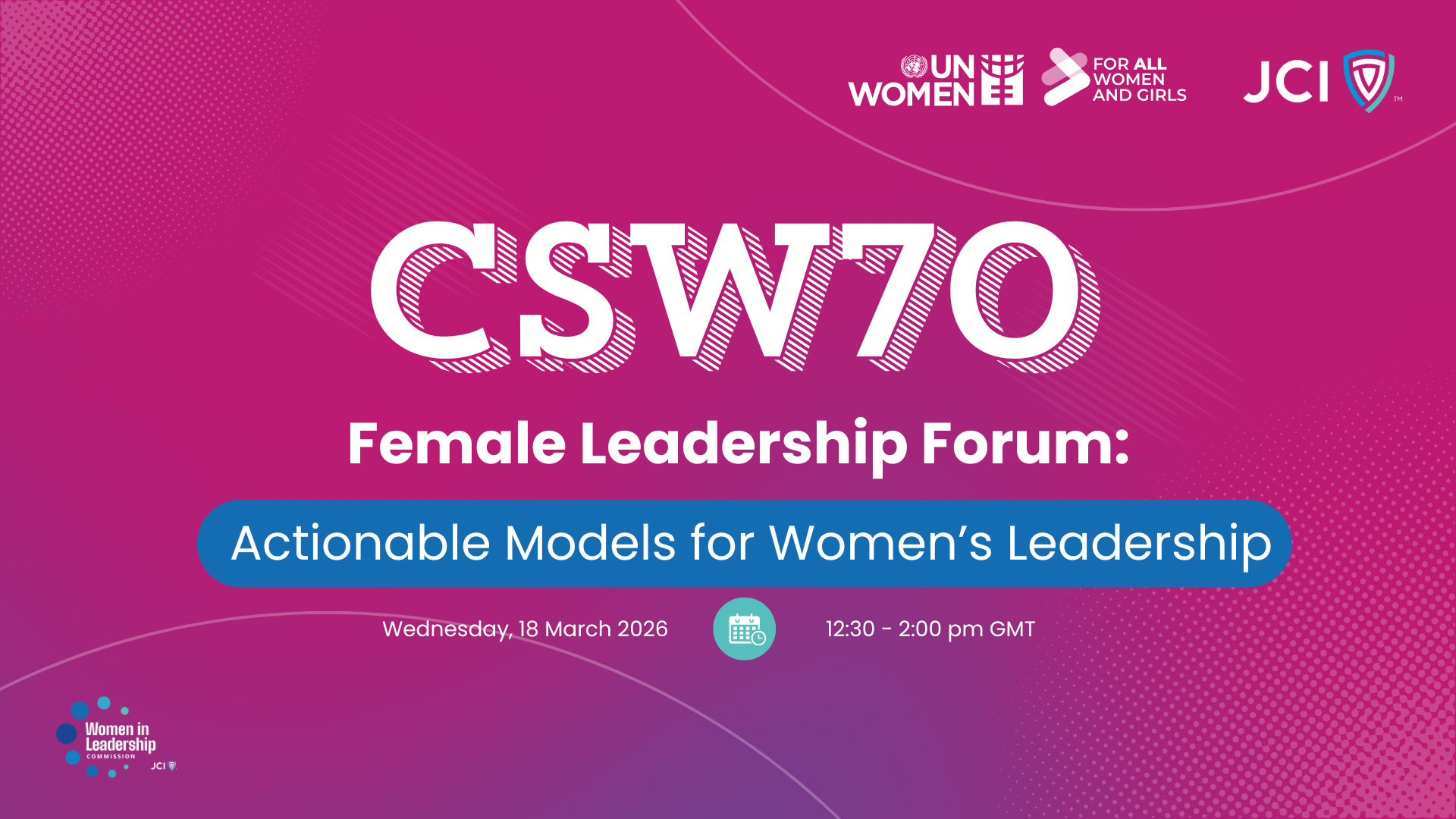
Female Leadership Forum: Scaling Impact: Actionable Models for Women’s Leadership
Hosted by Junior Chamber International (JCI) at the 2026 NGO CSW Forum 70, this virtual parallel event spotlights actionable and scalable models that strengthen women’s leadership across sectors and regions.
Date: 18 March 2026
Time: 12:30 – 2:00 PM GMT
Platform: Zoom
Languages: English, Spanish, French, Japanese
Interpretation: Provided
About the Event

In this target trial emulation study, prophylactic antibiotic use did not raise the risk of hospital admission due to antibiotic-resistant or urinary tract infections, however it did increase the risk of antibiotic resistance in uropathogens and multidrug resistance detected in urine cultures. This study offers new data on the absolute risk and number needed to harm for individual antibiotic resistance, which can inform shared decision-making discussions on preventing recurrent urinary tract infections (rUTIs).
The Lancet Obstetrics, Gynaecology, & Women's Health, Volume 2, Issue 2, February 2026, Pages e129-e139
This systematic review and meta-analysis of 81 included studies synthesised available data on the prevalence of postpartum haemorrhage and severe postpartum haemorrhage according to objective and subjective blood loss assessment methods and mode of birth (vaginal and caesarean). Authors report that the pooled rates of postpartum haemorrhage and severe postpartum haemorrhage were substantially higher when objective methods of blood loss assessment were used instead of subjective methods.
How Sex and Gender Impact Clinical Practice: An Evidence-Based Guide to Patient Care (Second Edition), 2026, pp 11-23
This chapter aligns with SDG 3 – Good Health and Well‑Being and SDG 5 – Gender Equality by demonstrating how gender‑informed communication strategies can improve clinician‑patient interactions, leading to better healthcare outcomes and more equitable, culturally aware treatment experiences for women and other gendered patient groups.
This chapter aligns with SDG 3 – Good Health and Well‑Being and SDG 5 – Gender Equality by examining how sex and gender shape public‑health issues such as intimate partner violence, access to healthcare, and infectious‑disease prevention, thereby supporting more equitable, informed, and effective care for diverse populations.
This article challenges the assumption that mixed-member proportional (MMP) electoral systems independently select candidates across tiers, showing that decentralized candidate selection in Germany links both tiers and limits women's representation. It finds that barriers women face in single-member districts persist in the proportional tier, undermining MMP's expected advantage for female candidates.