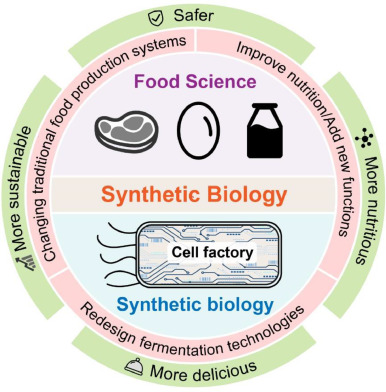
Food is essential to provide energy for human cellular metabolism, and is usually made from plants or animals. Beside plants and animals, other important food sources are made by microorganisms, typically products of fermentation (e.g bread, wine, beer, soy sauce, etc). Nowadays, because of the increasing environmental pollution, climate change and population growth, is becoming challenging to keep the food supply safe, nutritious and sustainable. Importantly, the development of the synthetic biology field enable the engineering of cells that can be used in food manufacturing.
Your search request returned 8466 results.

Elsevier, One Earth, Volume 2, 22 May 2020
Largely driven by the corporate sector, the recent surge of interest in trees as a solution to climate change has a distinct emphasis on planting trees. Realizing anticipated benefits will require managing the risks and trade-offs of land-use interventions and embracing the imperative of protecting existing forests.

Elsevier, One Earth, Volume 2, 19 June 2020
Climate extremes are expected to become more commonplace and more severe, putting species and ecosystems at unprecedented risks. We recommend that rewilding programs can create conditions for ecosystems to endure and recover rapidly from climate extremes by incorporating ecosystem engineers of various body sizes and life forms.
Elsevier, One Earth, Volume 1, 20 September 2019
Conservation of biodiversity and ecosystem services in natural environments requires careful management choices. However, common methods of evaluating the impact of conservation interventions can have contextual shortcomings. Here, we make a call for counterfactual thinking—asking the question “what would have happened in the absence of an intervention?”—with the support of rigorous evaluation approaches and more thoughtful consideration of human dimensions and behavior.
Elsevier, One Earth, Volume 2, 22 May 2020
Forests are key components of the global carbon cycle and dominate mitigation strategies for climate change and biodiversity loss. In contrast, the importance of and threats facing ocean forests—kelp forests—are comparatively underappreciated. Yet, increasing the global area of kelp forests would enhance biodiversity and drawdown CO2, mitigating climate change.
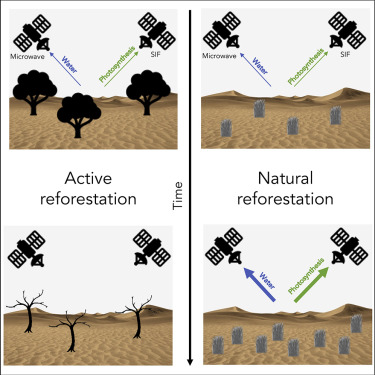
Elsevier, One Earth, Volume 2, Issue 1, 2020, Pages 98-108
We assess the success of natural reforestation in China's TNSP using satellite data. We use microwaves and SIF to measure water and photosynthesis in dryland vegetation. A strong correlation is found between reforestation and remote sensing data. Natural reforestation is successful at increasing vegetation activity in arid areas
Elsevier, One Earth, Volume 2, 24 January 2020
Is ecology, as a science, doing enough to address big environmental problems? Here, a review of the top 40 ecology journals suggests not. As ecologists, we have the opportunity to reinforce the relevancy of ecology to society through greater promotion and execution of solution-focused science.
Elsevier, One Earth, Volume 1, 25 October 2019
To conserve the bulk of Earth's ecological heritage across the Anthropocene, setting aside half of Earth's land is just a start. To conserve biodiversity over the long term across an increasingly human planet, conservation must become as integral to the human enterprise around the world as are social and economic development.
Elsevier, One Earth, Volume 1, 25 October 2019
Economic development projects are increasingly applying the mitigation hierarchy to achieve No Net Loss, or even a Net Gain, of biodiversity. Because people value biodiversity and ecosystem services, this can affect the well-being of local people; however, these types of social impacts from development receive limited consideration. We present ethical, practical, and regulatory reasons why development projects applying the mitigation hierarchy should consider related social impacts.